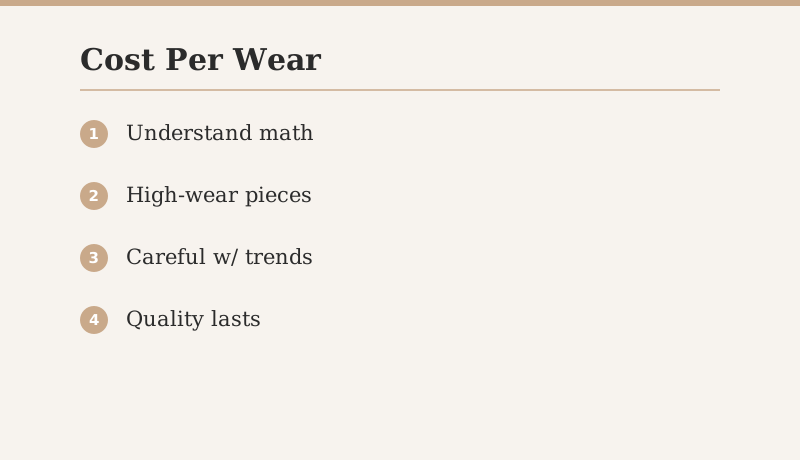
Cost Per Wear: How to Shop Smarter, Not More
That $300 coat isn’t actually expensive if you wear it 200 times. That $30 top isn’t actually cheap if it sits in your closet after two wears. Cost per wear is the one number that tells you which is really true — and once you start calculating it, you’ll shop differently for good.
Quick Answer: Cost per wear equals the price of an item divided by how many times you’ll realistically wear it — a $300 coat worn 200 times costs $1.50 per wear, while a $30 top worn twice costs $15 per wear. Use it to justify spending more on pieces you’ll wear constantly, and less on anything you’ll only wear a handful of times.

What Is Cost Per Wear?
Cost per wear is simply price ÷ number of wears. It’s a small piece of math that completely reframes what “expensive” and “cheap” actually mean. A $150 pair of jeans worn twice a week for two years — roughly 200 wears — comes out to well under $1 per wear, cheaper than a daily coffee. A $25 top worn once before it’s forgotten costs the full $25 per wear. The price tag alone tells you almost nothing; the math tells you everything.

Which Pieces Are Worth Spending More On?
The math favors spending more on anything in heavy rotation: coats, everyday shoes, go-to jeans, and basics you reach for weekly. If a coat costs $400 and you wear it three times a week across several winters — several hundred wears total — that’s under $1 per wear, genuinely inexpensive for a piece that’s in nearly every photo of you from October to March. As a rule of thumb, anything you’ll wear more than once a week is a strong candidate for a higher budget.

When Should You Spend Less?
Trend pieces and single-occasion outfits are where the math flips. A statement dress worn once for a wedding costs whatever you paid for it, full stop — there’s no “wearing it down.” For these, aim to spend modestly, rent instead, or shop your existing closet before adding something new. The rule is simple: the rarer the occasion, the smaller the budget should be.
Does Quality Actually Matter for Cost Per Wear?
Yes — cost per wear only works if the item survives long enough to rack up wears. A $300 coat that falls apart after 30 wears costs $10 a wear, worse than plenty of cheaper options. Quality construction — real stitching, natural fibers, sturdy hardware — is what lets a high-wear piece actually reach its low cost-per-wear potential instead of dying early.
How Do You Actually Track Cost Per Wear?
You don’t need an app or a spreadsheet, though both exist if you like that sort of thing. The simplest method is a rough mental tally: every time you wear a piece, make a quick note in your phone, or just estimate at the end of a season how many times you reached for it. After a year, divide the price by that number and you’ll have a real cost per wear instead of a guess — and it’s often eye-opening. That $80 “cheap” jacket you wore twice costs $40 a wear; the $250 coat you lived in all winter might cost $2.
What’s a Reasonable Cost-Per-Wear Target?
There’s no universal number, but a useful rule of thumb is aiming for under $5 per wear on everyday basics like jeans, sneakers, and go-to sweaters, and accepting $15-30 per wear as fine for special-occasion pieces you’ll only put on a handful of times a year. Anything landing above those ranges after a full season is a signal — either you’re not wearing it enough, or it was priced for a wardrobe role it isn’t actually filling.
Myth vs Fact: Cost Per Wear Edition
Myth: Cost per wear means always buying expensive. Fact: It means matching the price to the wear frequency — cheap is often the right answer for occasion wear.
Myth: You need to track every wear precisely. Fact: A rough estimate is plenty. You’re making a buying decision, not doing your taxes.
Myth: Fast fashion is always the cheaper option. Fact: An item that falls apart after five wears often loses to a pricier piece that lasts a hundred. Cheap and cost-effective aren’t the same thing.
FAQ
How do I estimate wears before I buy something?
Picture your actual routine: would you wear it weekly, monthly, or only for one event? Multiply a realistic weekly estimate by how many months or years you’d keep it, and you’ll land close enough for a useful number.
Is cost per wear only useful for expensive items?
No — it works both directions. It’s just as useful for talking yourself out of a cheap impulse buy you’ll wear once as it is for justifying a splurge you’ll wear constantly.
Does cost per wear account for resale value?
Not directly, but it’s easy to fold in — subtract the resale price from the original cost before dividing by wears. Pieces that hold resale value, like some designer bags, end up with an even lower true cost per wear.
TL;DR:
- Cost per wear equals price divided by number of times you’ll wear an item
- A $300 coat worn 200 times ($1.50/wear) beats a $30 top worn twice ($15/wear)
- Spend more on high-rotation basics: coats, shoes, jeans, everyday staples
- Spend less on trend pieces and one-time occasion wear
- Quality matters because a piece has to survive long enough to earn a low cost per wear
- Estimate wears roughly — you don’t need exact tracking, just a realistic weekly guess
Keep Reading
This article is for general styling and informational purposes only. Trends, sizing, availability and pricing may vary by brand and season.