Is Cashmere Worth It? The Honest Investment Guide
You’re standing in a store holding two sweaters that feel almost identical — one tagged $50, the other $800 — and both labels say “100% cashmere.” Something doesn’t add up here, and it’s not just markup.
Quick Answer: Cashmere is worth it when you buy quality — long fibers, 2-ply construction, tight knitting — and care for it properly, which usually means spending $200 to $300 on one honest piece instead of $50 to $80 on something that pills within weeks. Judge it by fiber length and ply, not the price tag alone, and a good piece can easily outlast a decade of cheaper replacements.
Cashmere confuses more shoppers than almost any other fabric: identical-looking sweaters priced $50 and $800, all claiming luxury. The truth involves fiber length, ply, and honest math.

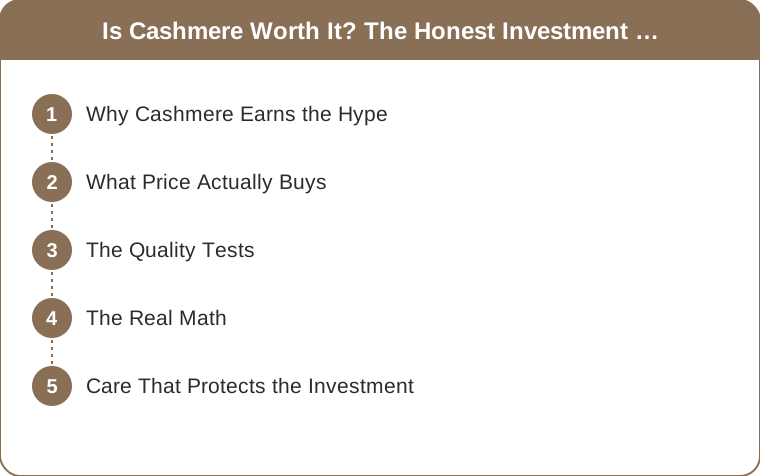
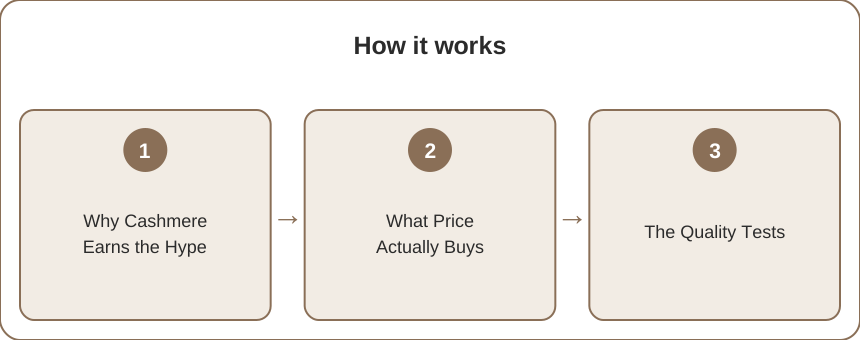
Why does cashmere have such a devoted following?
Cashmere fibers are finer than merino wool — that’s what delivers warmth without weight, and a softness that synthetic blends chase forever without quite catching up. A good piece feels like status and comfort at the same time, which is exactly why people get hooked once they own one.
The hype is physical, not just marketing. Once you’ve worn a genuinely good cashmere sweater, cheaper knits tend to feel scratchy or heavy by comparison.
What does the extra $200 in a cashmere sweater actually buy?
Long fibers (which resist pilling), 2-ply construction (which adds durability), tighter knitting, and more ethical sourcing — that’s what the $200+ price difference is actually paying for. Budget cashmere typically uses short fibers that pill within weeks of regular wear.
You’re paying for longevity, not the label or the brand name stitched inside the collar. A $60 sweater and a $300 sweater can look nearly identical on a hanger and behave completely differently after five washes.

How do you test cashmere quality before buying?
A few simple checks in the store tell you almost everything:
- Stretch it. Good cashmere recovers its shape; poor cashmere stays stretched out.
- Rub it gently. Immediate pilling under light friction usually means short fibers.
- Check the knit density by holding it up to light — tighter, denser knits last longer.
- Look for 2-ply minimum on the label or tag.
- Trust a slightly dry hand-feel over suspicious silkiness, which is often a sign of over-softened, weaker fiber.
Five minutes of testing in the store saves years of regret in your closet.
Is expensive cashmere actually cheaper in the long run?
Do the actual math and quality tends to win. One $250 quality crewneck worn 60 times a year for 8 years works out to roughly 50 cents per wear. Three $80 pilling disappointments replaced annually is worse math and worse mornings, since you’re staring at a stretched-out sweater before you’ve even left the house.
Cost-per-wear crowns quality almost every time once you actually run the numbers, even though the upfront price tag feels scarier.
How do you care for cashmere so it lasts?
Hand-wash it, or use a gentle cycle inside a mesh bag — dry cleaning is actually harsher on the fibers than most people assume. Dry it flat, never on a hanger, and fold it for storage instead of hanging it, which stretches the shoulders over time.
Use cedar blocks to deter moths, and de-pill gently with a fabric comb rather than picking at it with your fingers. Cared-for cashmere genuinely improves with age; neglect is the only true expense here.
Myth vs fact: buying cashmere
- Myth: A higher price always means better cashmere. Fact: price is a clue, not a guarantee — you still need to check fiber length and ply, since some overpriced pieces cut corners on both.
- Myth: Silky-soft cashmere in the store is the best sign of quality. Fact: that silky feel is sometimes a sign of over-softening treatments used to mask weaker, shorter fiber — a slightly dry hand-feel is often the better sign.
- Myth: Dry cleaning is gentler than hand-washing. Fact: dry-cleaning chemicals are often harsher on cashmere fibers than a careful hand-wash in cool water.
- Myth: Cheap cashmere is a harmless way to try the fabric. Fact: budget cashmere often pills so fast that it gets replaced repeatedly — the one that surprises most shoppers is that “trying it cheap” usually costs more over time than buying one good piece.
Is 2-ply cashmere always better than 1-ply?
Generally, yes for durability — 2-ply yarns are stronger and more pill-resistant. However, some well-made 1-ply pieces from reputable brands still hold up well, so ply is one signal among several, not the only one.
How can you tell cashmere is genuine before buying online?
Look for the fiber content listed clearly on the product page, check for 2-ply mentions, read pilling complaints in reviews, and buy from retailers with reasonable return policies so you can do the stretch-and-rub test at home.
Is it worth repairing pilled cashmere instead of replacing it?
Often, yes. A fabric comb or cashmere-specific de-piller can restore a lot of texture in minutes, and it’s far cheaper than replacing a sweater that otherwise still fits and suits your wardrobe well.
TL;DR
- Cashmere quality comes down to fiber length, ply, and knit density — not the price tag alone.
- Test before buying: stretch, rub, check density, look for 2-ply.
- A $200-300 quality piece often beats three $80 pieces on real cost-per-wear.
- Hand-wash, dry flat, fold (don’t hang), use cedar, and de-pill gently.
- Silky-soft in store can signal over-softened, weaker fiber — a slightly dry feel is a good sign.
- One well-chosen, well-cared-for piece can outperform a whole drawer of pilling pretenders.
Cashmere is worth it exactly once: when you buy quality (long-fiber, 2-ply, tested) and care for it properly. One honest $200-300 piece outperforms a drawer of pilling pretenders — in warmth, in years, in every cost-per-wear calculation.
Keep Reading
This article is for general styling and informational purposes only. Trends, sizing, availability and pricing may vary by brand and season.